One manager.
A dozen workers.
Zero babysitting.
Every week a Malay–English podcast drops a 90-minute episode. Within hours, with no one at the keyboard, a pipeline of LLM agents and deterministic scripts has transcribed it, corrected it, translated it and asked me to listen to the few words it isn't sure about. This page is about how that's orchestrated.
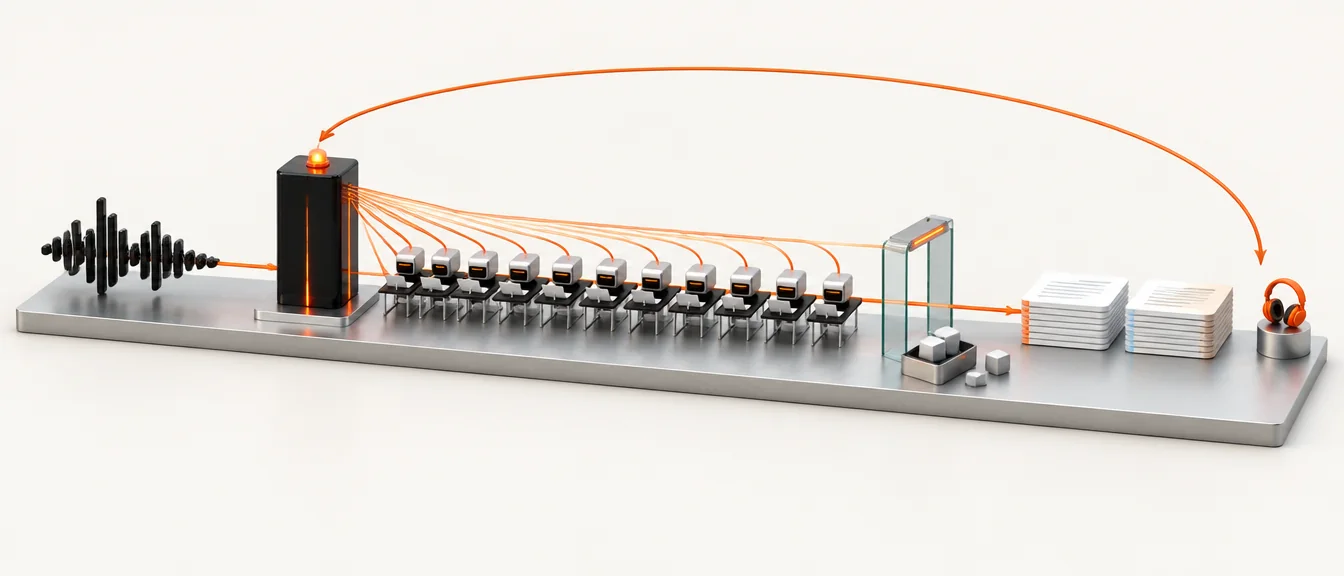
- Audio ina new episode is detected
- Managerplans and dispatches the waves
- Workers~12 run in parallel, one per chunk
- Gatescripts verify and reject bad edits
- Subtitles outMalay and English
- Ear-checkI listen to flagged words only
- Retro loopeach run improves the next
Agents decide.
Scripts do the arithmetic.
LLMs are good at judgement: is this a name, a garble or a stutter? They're bad at timecodes, budgets and file integrity. So every agent writes a small, typed list of edits, and deterministic tools apply, verify and gate them.
Eleven steps,
every week.
- Download & transcribeElevenLabs Scribe v2. The raw response is cached immutably, so re-chunking is free.
- Benchmark chunkOne worker fixes chunk 1 first and leaves notes that seed the wave.
- Garble sweepConditional, show-specific clean-up of known mis-heard terms.
- Fix waveWorkers correct words per chunk against a diagnostics punch list.~12 in parallel
- Split waveWorkers reshape long blocks into readable subtitles.parallel
- CombineChunks stitched; any unresolved flag blocks the build.script only
- Merge-short + clean-upLLM judges fragments; stutters, numbers and capitalisation are deterministic.
- QA & review listGlossary cross-check; only uncertain spans reach a human.
- TranslateAdaptive splitting into English, with an advisory coverage check.
- AnnouncePush notification and audio clips of every flagged word. Upload waits for my ear-check.I listen
- RetroThe manager writes an evidence-backed post-mortem with decision checkboxes.
What makes it
hold together.
 01
Workers emit edits, scripts own the file
A worker's only deliverable is an append-only edits.jsonl: replace, punct, insert, split, delete, flag or noop. A script builds the SRT and the report from it.
Whole-file rewrites caused silent truncation and timecode drift, and output tokens dominated cost. The ops file also makes a crashed worker resumable.
 02
Cache-ordered prompts, leader-first spawns
Every worker reads the same spec, context and glossary slice in the same byte order, with the one per-worker file last. The prompt has zero per-worker bytes.
One leader per provider cohort spawns first and warms the cache, and the followers start 75 s later. A simultaneous burst would just race the cache write.
 03
Routing as a budget control
The first four fix workers ride a fixed-cost subscription, and every retry falls over to pay-per-token. That bounds subscription spend by construction.
Providers are re-picked per episode for health, real cost and cache-hit rate. fp8 is the quantisation floor, and providers billing ~10× list price are hard-banned.
 04
A shared glossary, not shared context
Before searching, a worker looks the term up. On a miss, it claims the ASR spelling so no other worker duplicates the search, then registers the canonical form plus every garble it saw.
Free search runs first, and metered search only after a miss. Workers get an episode-relevant slice, not the 95 KB master file: that change saved ~28k tokens × 10 workers.
 05
A babysitter, not a router
A watchdog checks the manager every five minutes: nudge once, relaunch once on the retained session, then park and notify me. It enforces a budget ($1.50 warn, $3.00 park).
It never changes model or provider. Recovery and routing are separate jobs, so a stuck run can't quietly become an expensive one.
 06
Humans only where ears matter
The run holds its upload until I've listened to short clips of the flagged words. My verdicts go to a fresh session with a small deterministic brief, not to the manager's huge cold context.
The handoff is cheaper and more reliable, and the manager stays available as the fallback.
A pipeline that
writes its own retro.
Each run ends with a structural post-mortem. The agent that reports never applies a fix, and the agent that fixes never runs mid-episode. Only the next episode can mark a fix as verified.
What didn't work.
- Cheap model as manager on the subscriptionIt hit 103% of the 5-hour credit window twice on busy episodes, so the manager moved to a pinned pay-per-token model.
- Text-grepping logs for rate limitsIt missed a provider error that ends turns with zero tokens. Now it parses the last assistant turn, and any subscription retry downgrades unconditionally.
- Six subscription workersAt peak that's 98% of the window with no margin for retries, and off-peak it hit the request rate limit. Fixed at four.
- Merge-short as one giant LLM turnIt wedged silently 3/3 times. Rebuilt as script → batched LLM judgement → script, with a token-stream invariant check.
- A blind glossary sweepAliases polluted the glossary and rewrote common words into entities. The sweep now touches proper-noun-shaped, same-type matches only.